
Parking and traffic permits
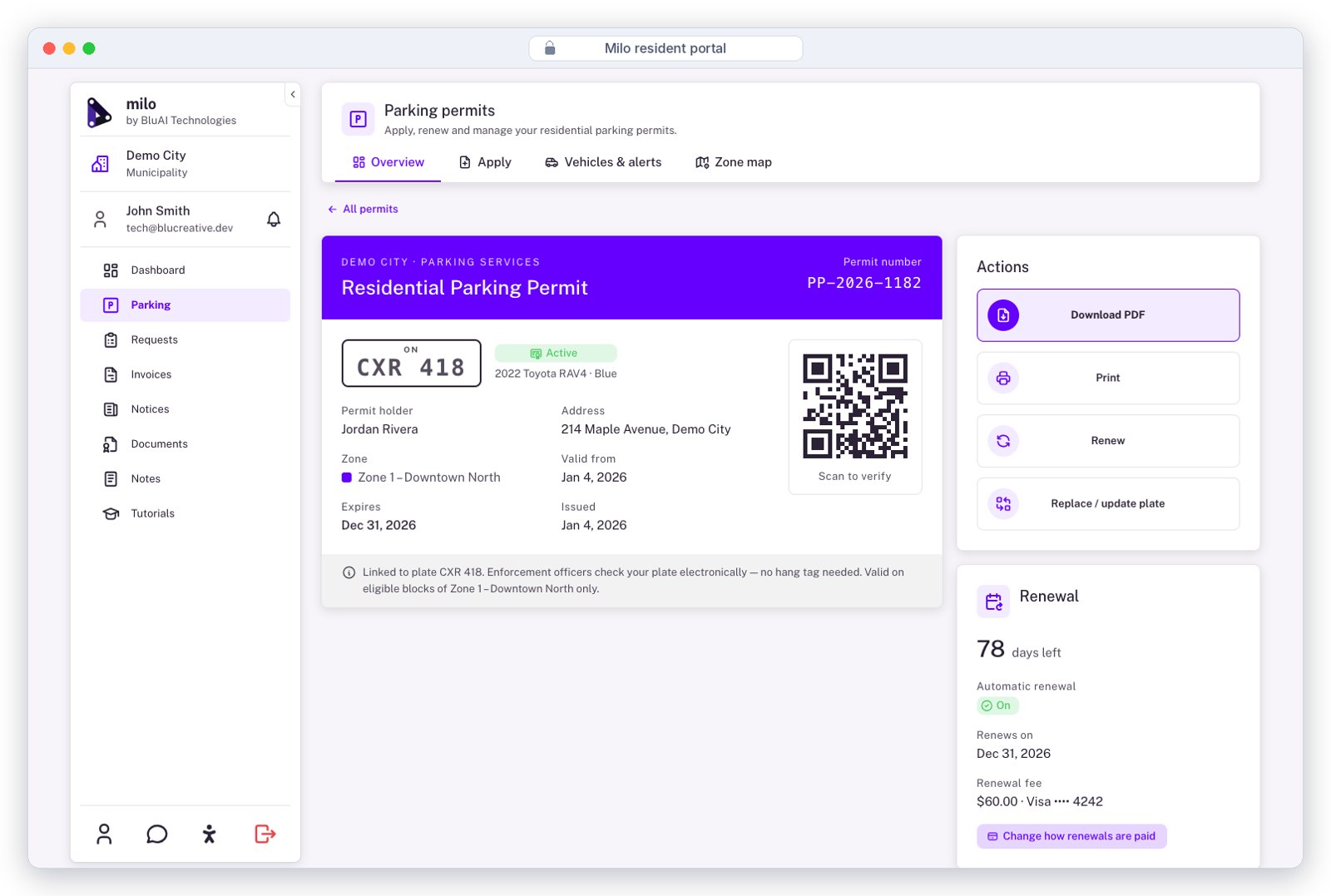
Residential, visitor, contractor and accessible parking permits tied to a licence plate and an eligible address. Zones come from your ArcGIS layer; eligibility is checked against your own address data, including civic-number ranges and side of street.
- Household limits and waitlists — max permits per address, waitlist position shown, auto-advance when a permit frees up.
- Enforcement sync — real-time push of permit and exempt-plate changes to AutoChalk or your LPR vendor, plus scheduled full sync.
- Exempt and special-entitlement plates — managed in one list with reason, zones and end date.
- Temporary and event permits — on-street permits for moves, construction and events, with dates and proration.
Business licensing
New licences, renewals, transfers and closures for every class you regulate — restaurants, contractors, short-term rentals, taxis, mobile vendors, lottery and liquor endorsements. Inspections are stages assigned to the right department; the licence issues only when every clearance is in.
- Per-class checklists — insurance, incorporation, food-safety certificates, police checks; each stamped and versioned.
- Multi-department clearance — fire, building, health and zoning each clear their condition from their own queue.
- Renewal season — pre-filled renewals, reminders by email and text, bulk approval for compliant files.
- Public licence lookup — optional read-only status page so residents can verify a licensed business.
- Application and documents (applicant)
- Application fee (payment)
- Zoning clearance (Planning)
- Fire inspection (Fire Services)
- Health inspection (Public Health — external agency seat)
- Decision: issue / conditions / refuse (Clerk)
- Licence fee (payment) → licence PDF with QR code
Pet and kennel licensing
Milo's original program, in production since 2021. Residents register pets with vaccination and microchip records, pay online or at the counter, receive a tag, and renew every year without re-entering anything. Animal control works the same files.
- Kennel and breeding permits — their own documents, inspections and fees on the same platform.
- Enforcement in the field — officers see files, add dated tasks, request a licence payment or issue a fine on the spot.
- Lost-pet posting and community notices — a managed page on your site with anonymous leads to the owner; seasonal notices by email and text.
- Tags, mail and arrears — medallion numbers assigned per account; invoices and renewals printed and mailed through our mail-out service; unpaid fees exported to the tax roll.
 Township of Essex, Ontario
Permits issued grew from about 1,200 in 2021 to over 2,300 in 2025 — new and renewed — across one online portal and three counter locations. Migrated to Milo 2.0 and renewed in 2026.
 SPCA de l'Ouest, Québec
Licenses animals for seven-plus municipalities west of Montréal on one multi-tenant Milo — each with its own fees, configuration and data — administered by the SPCA, not by each town.
Planning and zoning applications
Consents and severances, minor variances, site plan control, zoning by-law amendments, plans of subdivision and official plan amendments in Canada; variances, special-use permits, site plan review, rezonings and plats in the United States. Property-based and file-based: every application is tied to a parcel, and related files on the same property are linked.
- Agency circulation — conservation authorities, ministries, utilities and the county get scoped accounts; the stage tracks who has responded and reminds who has not.
- Conditions of approval — modelled as a stage with clearance assigned to the applicant, a City role or an external agency.
- Notices and reports — automated notices on triggers, your templates with editable sections, OfferioAI-compiled comment letters; PDF, Word or Google Docs.
- Development metrics — dwelling units, floor area and lot counts captured at each approval stage; processing time split staff vs applicant vs agency.
Parks, recreation and events
Facility and field bookings, special-event permits, road closures, film permits and park use. Insurance certificates upload as a required document; deposits and refunds run as payment stages; Public Works, Police and Fire clear their conditions from their own queues.
- Dates and availability — event dates on the file, conflicts flagged for staff.
- Deposits and damage holds — authorize-then-capture, released or kept after the event.
- Community notices — closures and event advisories to registered residents by email and text.
Special event · Road closure · Park pavilion booking · Sports field permit · Film and photography · Parade · Fireworks display · Block party · Mobile food vendor at events
Municipality · agencies and shared-service programs
One platform, many municipalities.
SPCAs, humane societies, regional service commissions, counties and shared-service agreements run several municipalities on one Milo — each with its own configuration, fees, branding and data, administered centrally.
Multi-tenant
Each member municipality isolated; the agency sees the whole program; revenue reported per member.
Standalone dedicated instance
One municipality, one environment, your domain — the default for towns and cities.
DynaCore-integrated
Website and permitting from one provider, with Milo embedded in your DynaCore site.
 Regional service commissions and shared-service bodies are a natural fit for the multi-tenant model.
Other permits
If it has an application, a review and a fee, Milo can run it.
Use case · White paper
From a by-law nobody enforced to 2,300 permits a year.
How the Township of Essex moved pet and kennel licensing online with Milo, gave animal control the same file as the clerk's office, and turned an uncollected fee into a program residents renew every year. Includes the rollout timeline, the fee and arrears model, and what changed in Milo 2.0.
- 12 pages · PDF · English and French
- Sent to your inbox within a minute of submitting
- No mailing list — one email with the file, nothing else
Get the white paper
Fill in a short form — name, email and organization — and the PDF is emailed to you right away. Telephone is optional.
Make sure the email you enter is accurate: that is where the case study is sent.
Bring your by-law. We'll bring the workflow.
First permit live in 30–60 days; each one after in 1–3 weeks.