
Key takeaways
- Build the application around what your local rules require, and nothing more.
- Issue a registration number that operators must show on their listings, and give the public a way to verify it.
- Plan for renewals and complaints from the first day.
Many municipalities now regulate short-term rentals. The rules differ from place to place. Some allow only a principal residence. Some cap the number of nights or the number of permits. Some require an inspection.
Whatever your rules say, the licensing process has the same parts. Getting them right decides whether the rule can be enforced. This guide is about the process, not about which rules to adopt.
Decide what the application must prove
Go through your rules line by line, and turn each requirement into a question or a document. Depending on the rules, that may include:
- Proof of ownership, or the owner's written consent.
- Proof that the unit is the operator's principal residence, where required.
- Proof of insurance.
- A floor plan with the number of bedrooms and the maximum number of guests.
- A parking plan.
- A local contact who can respond at any hour.
- A fire-safety declaration or inspection.
Ask only for what the rules require. Every extra document is a reason for an honest operator to stay unregistered.
Route inspections to the right department
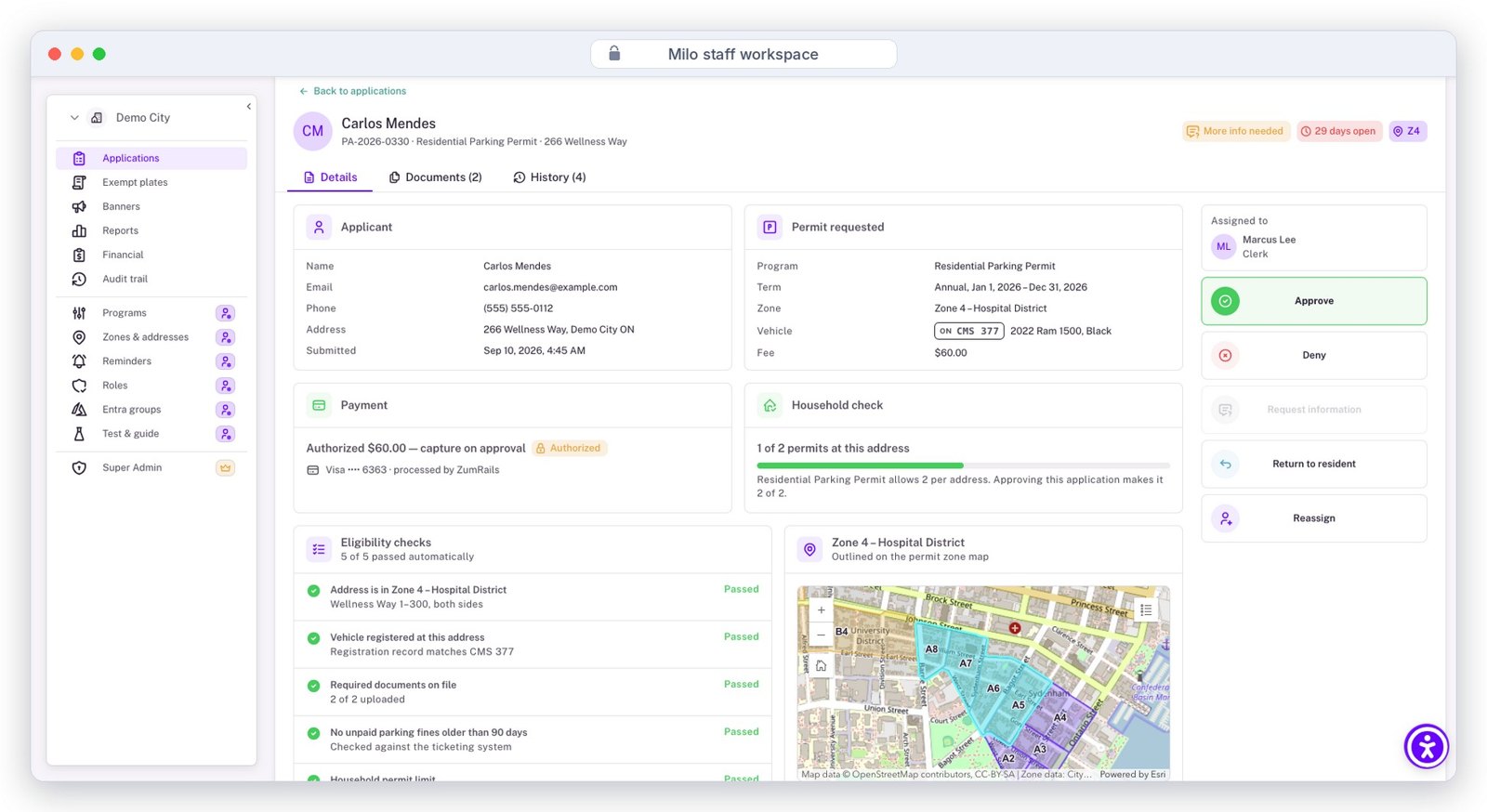
If your rules call for a fire, building or zoning check, make each one a stage owned by that department. Each clears its own step from its own queue. The approval is issued only when all of them are in. Short-term rentals work as one class of business licensing in Milo, next to restaurants, contractors and mobile vendors.
Issue a number, and make it checkable
Give each approved rental a registration number, and require operators to show it on every listing. Then give the public a way to check it. A read-only status page lets a resident or a guest confirm that the number is valid and matches the address.
A listing without a valid number is then easy to spot, for your staff and for the booking platforms.
Caps and waitlists
If your rules limit the number of rentals, per zone or in total, the process needs a fair queue. Open and close applications on set dates. Show each applicant their position on the waitlist, and move the list forward when a permit is given up.
Renewals and changes
Most programs renew every year. Send reminders before the expiry date, pre-fill the renewal and ask only for what expires, usually the insurance certificate. Decide in advance what happens when a property is sold. In most programs the approval does not transfer, and the new owner applies again.
Complaints and enforcement
Noise, parking and garbage complaints are the reason most of these rules exist. Record each complaint on the rental's file, with a date and an outcome. Enforcement staff should work the same file as the clerk. At renewal, the history is then in front of the person making the decision.
Start simple
You can launch with the application, one inspection and the registration number. Add the public lookup and the waitlist when the first season shows you what is needed. In Milo a new class like this is built by copying an existing workflow and adjusting it, typically in one to three weeks.